Musk Disputes NASA Panel's Starship Refueling Estimate for Moon Landing
Elon Musk says the number of launches needed to put astronauts on the Moon will be less than half the 22 flights cited by a NASA safety panel member.
By News Media House Staff ·
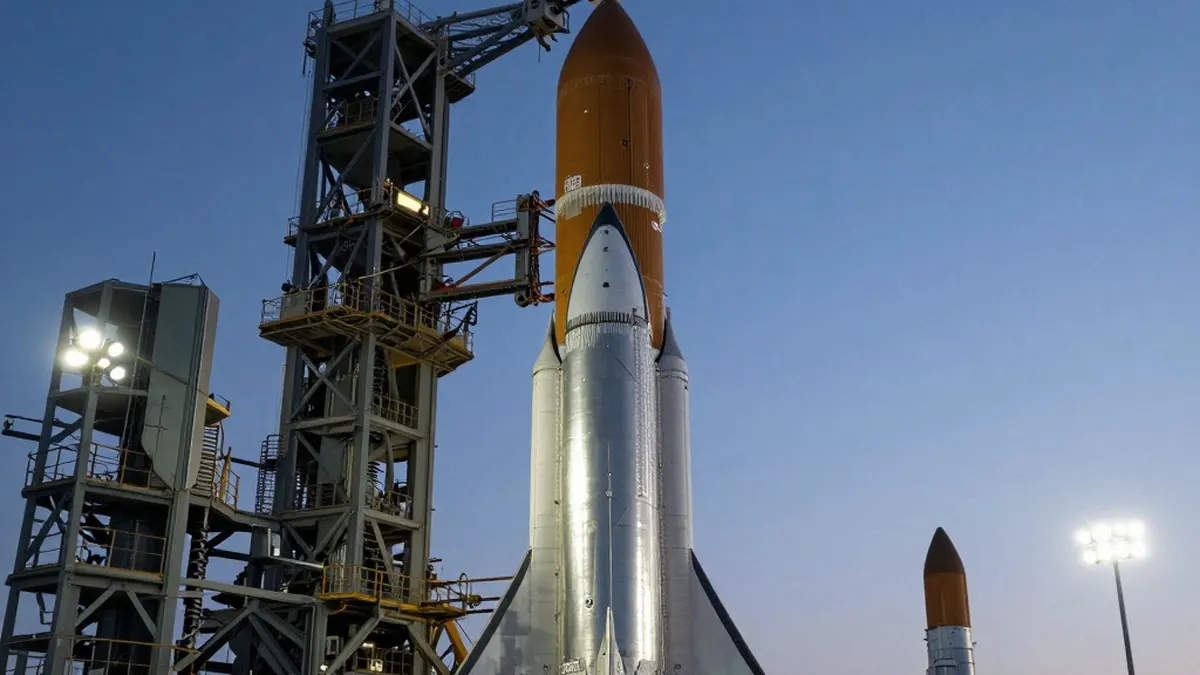
Elon Musk is challenging a NASA safety advisory panel's estimate of how many Starship launches will be needed to land astronauts on the Moon, arguing the real figure will be far lower than the one the panel cited.
The dispute emerged after the Aerospace Safety Advisory Panel held its quarterly public meeting on Thursday. Panel member Charlie Precourt, a former NASA astronaut, identified the fueling of SpaceX's lunar lander as a major risk for Artemis IV, the mission planned to put a crew on the Moon in 2028. "We need to keep our eyes on numerous required fuelings for the lander," Precourt said, as reported by Ars Technica. "I think the last estimate is around 22 flights."
Ars Technica's Eric Berger shared the remark on X, prompting a reply from Musk. "That's way too high," Musk wrote. "Actual number will be more like 6 to 8."
The argument stems from a basic limitation of using a vehicle as large as Starship for lunar missions. The rocket uses nearly all of its propellant just to reach Earth orbit, so it cannot travel on to the Moon without being refilled. SpaceX's solution is an orbital fuel station. A Starship configured as a storage tank, known as a depot, is launched first. Tanker Starships then fly one at a time, dock with the depot and transfer their remaining propellant. When the depot is full, the lunar lander version of Starship launches, docks, fills its tanks and departs for the Moon.
Because each tanker flight is a complete rocket launch, the total matters a great deal. More launches mean additional time and cost, and more opportunities for problems before a crew leaves Earth. Berger estimated that even if SpaceX manages two Starship launches per week by the end of 2027, filling a depot at the panel's figure would still take about three months.
The number of tankers required depends largely on how much propellant each can deliver to orbit and how much is lost along the way. Starship's fuel and oxygen are kept at extremely low temperatures, and some slowly boils off while waiting in orbit, with further losses during each transfer. NASA appears to be basing its estimate on what Starship can lift now, while Musk's range assumes a more capable vehicle.
Musk has contested higher counts before. In 2021, after a government document suggested 16 launches, he called that "extremely unlikely" and said eight tankers would be the most that would be needed.
Much of the answer hinges on hardware SpaceX has yet to fully fly. As Teslarati noted earlier this year, the company plans to carry out refueling with its upgraded V3 Starship. Precourt said Artemis IV carries "a large number of firsts." He also commended the team of NASA Administrator Jared Isaacman for working to remove obstacles for both SpaceX and Blue Origin, whose Blue Moon lander does not depend on orbital refueling for its first mission.
Originally published by News Media House · Source: Teslarati